These tiny nutrient makers

Rocks break down slowly when CO2 dissolved in rain water forms carbonic acid. Chemists represent it as:

CO2 + H2O ,<=> H2CO3

When carbonic acid encounters calcium silicate rocks (like basalt or granite) react to form diverse forms of carbonates. This is one of the forms rocks break down to form soils and liberate minerals that support life of organisms. But if we would rely purely on chemistry, the forming of soils could take a long time. Life cannot afford to wait and found another wait of self supporting.

In 1989  D.W. Schwartzman and  T. Volk compared rock break down in sterile conditions and in presence of soil biota. In presence of life, decomposed  up to 1000 times faster in presence of microorganisms. Biology produces enzymes and acids, creates a protective environments and speed up the process of rock weathering. In fact, soil biology weather rocks fast enough to feed the ecosystems and to compensate the washing by rain and wind.

As result of the activity of microorganisms, soils are able to create a nutrient bank (humus) that enable the successful development of more complex plants, which we call food. Fertile soils are successful in keeping the soil life functional at extracting minerals to feed crops.

Ecosystems rely on these processes of bringing minerals from rocks to the biosphere. Rockin Soils encourage farmers to understand and use these natural principles to mimic biological systems, to reproduce soil microbes and use them to dissolve rocks aiming and get all fresh minerals. This allow farmers of any country to boost production of nutrient dense food while improving the soil fertility.
International Webinar: Soil Biology & Water Harvesting

Date: February 19, 2015

Description:
Soil fertility is a function of the wide range of organisms living in the soil, such as earthworms, nematodes, protozoa, fungi, bacteria and arthropods. They all work together to decompose organic matter, solubilize minerals from rocks and form complex molecules and humus. Humus is the base of life again as it forms soil structure, acts as nutrient bank and forms a nurturing ecosystem for plants to grow healthy. Soil biology studies this complex ecosystem and the ecological functions that it performs.

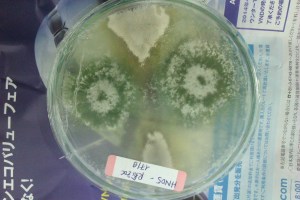
Soil fungi, blocking the growth of a pathogen. Vietnam 2014.

Soil moisture supports this microbial activity within the soil, which means that water harvesting and moisture management greatly affect soil fertility.

In this webinar, Ruben Borge discusses the basic principles and emerging concepts of soil biology relevant to agriculture. He also draws some relations to water harvesting, and their potential effects on soil life.

From crop calendar to business planning

Tanzanian farmers plan the application of organic fertilizers with a simple form of crop calendar. Together with the farmers we created a graphic that integrates all the activities of a season. This allows farmers to match their treatments and cultural activities as pruning and applications of mineral additives to rain season, crop development stages, and other periods of mayor incidences of pests and diseases. The photo shows a calendar for coffee (kahawa in Suahili)

Based upon this simple tool for planning activities we are able to start talking business with the farmers. this is because with this planning farmers build the bridge to start thinking in quantities of materials and ingredients and labor needed.

In june 2014, 25 farmers started a business planning course at coffee cooperative of Mbinga, Tanzania. The outcome of this course was a draft of a business plan that would allow farmers to join efforts to produce organic fertilizers and offer them to other farmers within their cooperative.

One year later, this business plan turned into real business as farmers are now producing  organic fertilizers for the first 100 customers and have a potential market of 1500 farmers and near 4000 hectares.