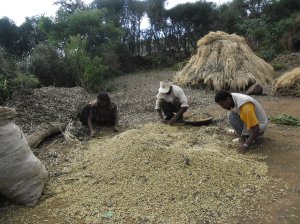
Abere is 70 years old farmer who leases about 0,5 hectares of clay farm land at an slope in the remote village of Rema, Ethiopia. She walks everyday on her bare foot observing the growth of her crop for many years and doing all the manual weeding. As chemical fertilizer was too expensive for her, she never applied it. With the years her land has lost its fertility.
Moved by the experiment on organic fertilizers in Rema, she wanted to try them at her farm. The family owns 2 cows and 2 Cebu’s and 2 oxes that provide for milk and work power to plough the land. Before the bio-fertilizer program the family dried some dung and sold it as fuel for the kitchens the rest of the dung was disposed. This is common in Ethiopia. Now most of the dung is used to produce ferments that improve the land the farm and support the growth of at the family’s kitchen garden, pepper, garlic and potato’s and also for the farm to produce beans and barley. Experience on Faba bean. Abere grows barley and faba bean. On 400m2 barley she applied Bocashi 1,5 ton/ha en on 800m2 Faba bean she made 3 applications of liquid bio-fertilizer, at the stages of seedling stage, flowering, fruiting. In the whole cycle faba beans she applied a total of 10l of liquid fertilizer produced at their home and spread in three applications.
Abere described the crop development with enthusiasm. Her son took pictures to illustrate the development of this crop. Faba beans showed good growth and vigour. The flowering and fruiting was supported by the addition of self-made potash fertilizer. Abere was impressed with the flowering and the number of pods per plant. She was happy to get 1 or 2 pods per flowering bud. This year she was getting up to 6. And each plant gave her between 7 and 9 buds. This means that each plant gave between 80 and 90 pods. Without any fertilization, the harvest of faba beans was in the past between 100 and 200 kg in 800 m2 (2,5 ton/ha). With self-made fertilizers, she got 500 kg (6,2 ton/ha). This was beyond her expectations and harvesting was a celebration. The cost of this fertilizer was only the preparation of the fertilizers because all materials are available at the village. She produced all she needed with no investment and did not need any financial support. Production of fertilizer cost her 3 days of extra work in the season. More and more farmers are interested in these fertilizers and want to learn about how to produce them and try them at their farms.
Rockin Corn
The secondary School of Arsi Negele, is testing rock dust enriched fertilizers in maize. The test consisted in the application of basalt rock dust in the farm land and the application of 2 treatments of maize with liquid bio-fertilizer. Results of this crop are compared with the performance of a plot with urea en DAP. The maize harvested in December 2nd 2013.
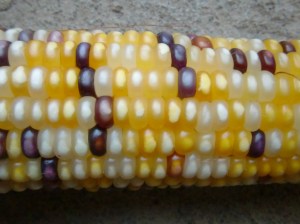
Maize under the test is performing good. It shows better development of the green leaves, flowering faster, is able to fill the grains better than the control. A few weeks after the sowing, maize leaves started to show signs of fungal disease, as reported from the field. The tested field was sprayed with self produced liquid bio- fertilizer. Three days after the treatment maize had restored the dark green colour in its leaves. This is possibly the reason why later the corn stalks with bio-fertilizer have shown better development. Other experience in maize in the demonstration site of Rema (northern Ethiopia) confirm these results.
Due to the low costs (self-produced fertilizer cost almost 10x less than chemical fertilizers) and the positive environmental impact, the school is inviting students and farmers to see and learn about this new approach. Between March and November 2013 the school was visited by more than 200 farmers interested in this approach.
Parallel to this project the Technical school of Arsi Negele is carrying out a similar research, in teff, a local grain highly demanded in Ethiopia. Teff under organic conditions had better germination and resulted in higher crop density. Moreover the there are more tillers per plant (up to six). The superior quality of the organic teff and the increased production has shown the students the importance of the management of the local resources to ensure high productivity with less investment.
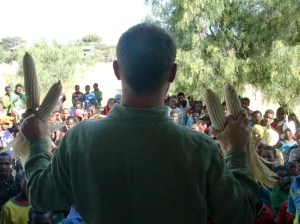
The school farming activities generate resources that are reinvested in the school. The good financial result of the organic fertilization will allow the school to improve their facilities and curriculum. The participation of the school in this research motivate and empower the future farmers to learn this approach.
Rockin Soils works with educational centers to show the future generations that healthy regenerative farming offers a better future for them and for all.
Assessing Soil’s microscopic work force
Life in the soil is the engine that moves nutrients. Resilient soils are living soils. Plants are at the highest levels of the soils trophic pyramid and depend on the soil food web to survive. Farmers quest to gain security on their harvest drive their attention to soil life.
For nutrient cycling and the crop resilience, soils with biodiversity perform better than soils with domination of one particular “beneficial” specie. Still industry sells inoculates with specific functions. These specific inoculations tend to create imbalances in the soil and difficult the natural nutrient cycling. Resilient healthy soils have great diversity in life in all its forms.
How to assess life in the soil?
In Rockin Soils we strive to provide farmers with quick-cheap-easy methods to assess the soils conditions
Indirectly these are the most common indicators:
- Root density
- Holes and signs of life.
- Diversity in plants potential “hosts” of different forms of life.
Directly here we have a list of indicators to assess macro-live in the soil:
- Macro-life in the soil as birds, moles that feed themselves with worms and insects.
- Earthworms, type and quantity
To assess microscopic-life
- Observation of fungal micelium in the crop rests
- Rice-trap test gives an idea of the diversity of the fungi and bacteria of the soil. (photo)
- Water peroxide test
- Tea bag decomposition rate
- Cow dung decomposition rate
Rockin Soils assists farmers to assess the soil life and to implement measures that enhance it. Rockinsoils helped to adapt the Visual soil assessment for the Netherlands. for more info look at http://mijnbodemconditie.nl/ (sorry, this site is only in Dutch)