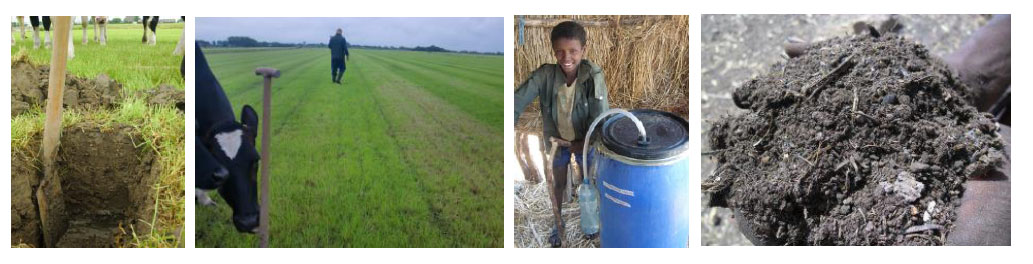
Practical soil biology course series for Dutch Farmers (in Dutch)

This course series is given in Dutch language.

Spuitlicentie (TEELT): Bodembiologie als wortel van uw bedrijf (één spuitlicentie punt)

Om de spuitlicentie te houden dien je 4 punten te halen in vier jaar. Deze cursus verschaft je één punt. Deze puntenadministratie wordt beheerd door bureau erkenningen.

De kosten voor deze cusrsus bedragen €40,- per persoon.

Doel: Deze cursus biedt praktische kennis en ervaring met betrekking tot het kringloop-denken. Bijvoorbeeld het juiste gebruik van compost, Bokashi en drijfmest om de gezondheid van bodem, plant en dier positief te beïnvloeden.

Bedoeld voor: Agrarische ondernemers die willen weten waarom en hoe we bodems vruchtbaarder en productiever kunnen krijgen en mensen die geïnteresseerd zijn in de optimalisatie van voedselproductie met lokale input.

Docent: Ruben Borge (Spanje, 1976) werkt samen met (kleinschalige) boeren uit Europa, Azië, Afrika en Amerika om de bodembiologie en mineralogie te verbeteren. Doormiddel van simpele technieken leren boeren om hun bodem gemineraliseerd en gezond (levend) te krijgen. Na het herstel van de biologie en mineralogie, kunnen bodems gezondere en rijkere gewassen opbrengen met minder productiekosten.

bodemvruchtbaarheidcropped-rockinsoils-logo-web-green2

Inhoud:
Lezing: (1,5 uur)
• Waar is de microbiologie in en rondom een landbouwbedrijf.
• Wat is de functie van microbiologie in de bodem, in het dier en in de mens.
• Herkennen van het verschil tussen een gezond en ongezond systeem.
• Wat zijn de consequenties voor de boer/gebruiker.

Praktijk (1,5 uur)
• Strategie voor de verbetering van biodiversiteit op uw eigen bedrijf.
• Winning en reproductie van microben.
• Maken van chelaten in fermentatievat: biologische extractie van nutriënten uit mineralen (gesteenten en zee-mineralen)

 

Zie beschikbare data en inschrijving

This course series is organised by:

Mulder Agro Inschrijvingen


Life is back

Only one month after soil aeration in Raerd with the Evers plow, we find new signs of life are visible in the soil more root growth, earth worms, insects. We also see the effects of their work in the channels they leave in the soil. Soil drains better now

How we made it:

  1. Visual soil Assessment. This gave us an idea about what were the key constraints that affected the gras production. Heavy clay soils of Raerd need to be managed to allow root forming and avoid soil compaction.
  2. Assess the land and water management. We saw that with the current land management, the soil will tend to compact and create an environment with little air and water exchange. This environment would  stress the root and compromise the grass production.
  3. Designed a new fertility plan that include building soil structure in permanent grassland with structural help of the vertical plow. This use will compensate the imbalances of the use of machinery. Once the right soil conditions are created to allow successful biological settlement and nutrient cycle.


Course series on low-cost agriculture in Tanzania

Rockin Soils works with Agriterra to organize a series of courses for farmer cooperatives in Southwest Tanzania, to improve the quality of maize, beans and Coffee with affordable organic inputs.

Conventional farming practices rely on chemical fertilizers and pesticides that most farmers cannot afford. Access to information about reliable self-made organic inputs is in high demand in Tanzania.  The skill to upcycle farm refuses, recover nutrients and improve the soil is scarce and farmers end up in situations where they dispose or burn valuable resources and soon after they go for a loan to buy fertilizers.

With the application of Visual Soil Analysis (FAO, 2008) in the farms, we see that all the assessed farms have lost a good part of their Soil organic content. Giving the climatic conditions of the tropical areas, we estimate that the continued use of chemical inputs combined with the current farm practices of kill, harvest, dispose and burn, will lead to decrease of soil fertility in the short term. Less fertile soils will demand more external inputs and increase the risks (economical, ecological and social) of the farmers. While farmers dependency on external inputs grows, their capacity to cover the costs or access loans remains insufficient.

Image soil condition check

lab-less soil check carried out in the south of Tanzania

The regeneration of the farm soil is the logical strategy to ensure that farmer families can keep farming and make a living.

The courses integrate the simple lab-less techniques to assess the soil condition, the production of organic inputs and regenerative farm practices, nutrient recovery, water harvesting and moisture management. The more than 60 model farmers and local extension officers are optimistic about the potential of this approach for small farm operations, as well as for local commercial enterprises.

CIMG5285